

Struck by a Food Delivery Rider on a New York City Sidewalk or Crosswalk? Here’s Who May Owe You
Key Takeaways: When a delivery e-bike strikes a pedestrian in NYC, liability can extend beyond the rider to the restaurant, delivery platform, negligent third parties, or manufacturers of defective bikes or batteries. Because pedal-assist and throttle-assisted bicycles are generally not "motor vehicles" under Insurance Law § 5102, No-Fault benefits often do not apply, making it critical to identify every potentially responsible party and available policy. This classification may benefit injured pedestrians, since the Article 51 serious-injury threshold generally does not bar pain and suffering claims against bicyclists. Most negligence claims must be filed within three years under CPLR 214, but intentional-act, wrongful death, and municipal claims carry shorter deadlines. Because e-bikes can be hard to trace and surveillance footage is often overwritten quickly, preserving evidence immediately is decisive.
When a delivery e-bike hits a pedestrian in NYC, liability rarely stops with the rider. Responsibility may extend to the restaurant that dispatched the order, the platform that controlled the route and timing, third parties whose conduct contributed, and manufacturers of defective bikes or batteries. New York negligence law asks who owed a duty, who breached it, and whose breach caused the harm.
If you were hit by delivery e-bike NYC traffic made unavoidable, the team at The Newman Firm is ready to review what happened. Call (718) 896-2700 to discuss your options, or contact us now to request a case evaluation.
Why E-Bike Cases Look Different From Car Cases
The core distinction is insurance. A collision with a private automobile typically triggers New York’s No-Fault system, which pays basic economic loss regardless of fault. A collision with a bicycle or e-bike generally does not, because that system is built around motor vehicles. An injured pedestrian may need to rely on health insurance, the rider’s personal liability coverage, or a commercial policy held by a restaurant or platform.
Whether a particular e-bike qualifies as a "motor vehicle" is a threshold legal question. Under N.Y. Insurance Law § 5102, terms such as "motor vehicle," "covered person," and "serious injury" carry defined meanings. New York’s Vehicle and Traffic Law separately defines Class 1, 2, and 3 "bicycles with electric assist," which are generally not registered as motor vehicles. If a device does not meet the statutory definition, no-fault benefits are unavailable.
One benefit of that classification may favor the injured pedestrian. New York’s serious-injury threshold restricts recovery for pain and suffering in claims involving covered persons under Article 51. Where the defendant is a bicyclist or e-bike operator, that threshold generally does not apply, meaning non-economic damages can be pursued without satisfying it.
Sorting Out E-Bike Liability NYC Claims Party by Party
Start with the rider, then work outward. A delivery rider who runs a red light, rides against traffic, or rides on a sidewalk may be liable for negligence, and violations of the Vehicle and Traffic Law or City traffic rules may be offered as evidence. But riders frequently have limited assets and insurance, which is why experienced counsel rarely stops there.
The Restaurant or Delivery Company as Employer
Restaurant employer liability may arise when the rider was acting within the scope of employment. Under respondeat superior principles, an employer may be answerable for an employee’s negligent acts committed while performing job duties. Courts examine who controlled the manner and means of the work, who set delivery quotas, who supplied the bike, and how the rider was compensated and scheduled.
Classification fights are common and fact-intensive. Many platforms characterize riders as independent contractors to contest vicarious liability. Courts consider the actual degree of control exercised rather than the contract label.
Negligent Hiring, Training, and Supervision
Even where vicarious liability is contested, a direct claim against the company may remain available. Theories of negligent hiring, retention, training, or supervision focus on the company’s own conduct. Such claims generally require proof that the company knew or should have known of the worker’s propensity for the conduct that caused the injury. Evidence of unsafe riding history, pressure to complete deliveries within unrealistic windows, or failure to enforce safety rules may support these claims.
Product Defects and Third Parties
Sometimes the rider was not the only cause. A failed brake, throttle malfunction, or battery fire may shift responsibility toward a manufacturer under product liability principles, with a three-year deadline under CPLR 214(5). Third-party liability e-bike theories may also reach a driver who opened a door into a bike lane or a property owner whose obstruction forced a rider into a walkway. If a municipal vehicle or defective roadway contributed, different and often shorter deadlines may apply.
Deadlines That Can End a Delivery E-Bike Claim NYC Residents Never Filed
The general rule is three years. N.Y. C.P.L.R. § 214 establishes a three-year limitations period for actions to recover damages for personal injury, and the New York courts’ statute of limitations timetable lists "other negligence resulting in personal injury" as three years from the date of the accident under CPLR 214(5).
Several important exceptions run much shorter, and courts interpret them strictly.
| Type of Claim | Deadline | Authority |
|---|---|---|
| Negligence causing personal injury | 3 years from the accident | CPLR 214(5) |
| Product liability (personal injury) | 3 years from the injury | CPLR 214(5) |
| Assault or battery (intentional act) | 1 year from the act | CPLR 215(3) |
| Wrongful death | 2 years from the date of death | EPTL 5-4.1 |
| Claim against New York City or State | Notice of claim in 90 days; suit generally in 1 year and 90 days | General Municipal Law §§ 50-e, 50-i |
Pleading decisions can quietly shorten your window. If a rider’s conduct is framed as an intentional act rather than negligence, the civil deadline may shrink from three years to one under CPLR 215(3).
A discovery rule exists, but it is narrow. Under CPLR § 203(g), where a limitations period is measured from when facts were or reasonably could have been discovered, the action generally must be commenced within two years after that discovery, or within the otherwise applicable period, whichever is longer.
💡 Pro Tip: Municipal notice-of-claim requirements are separate from filing a civil lawsuit. Missing the 90-day notice window can jeopardize a claim against a public entity, although late-notice relief is sometimes available by court permission.
Comparative Fault Rarely Ends a Case
New York applies pure comparative negligence, so partial fault generally does not close the courthouse door. Under CPLR 1411, a plaintiff’s contributory fault may proportionally diminish his or her recovery, but will not preclude recovery unless the plaintiff was solely at fault. The Court of Appeals affirmed this principle in Rodriguez v City of New York, 31 NY3d 312 (2018), holding that plaintiffs need not disprove comparative fault to obtain partial summary judgment on liability. A pedestrian who stepped outside a crosswalk or looked at a phone may still recover, with damages reduced by the assigned percentage.
Expect insurers to press comparative fault aggressively. Contemporaneous evidence, including camera footage, bystander video, and witness accounts, often influences how a jury allocates e-bike collision fault.
Finding the Insurance That Actually Pays
Locating coverage is often the difference between a paper verdict and a real recovery. New York litigation procedure requires defendants to disclose insurance information, generally within ninety days after service of the answer.
In a commercial delivery case, several policies may be stacked. Potential sources include:
- A restaurant’s commercial general liability policy
- A delivery platform’s contingent or occupational accident coverage
- The rider’s personal liability or homeowners/renters coverage
- Excess or umbrella policies sitting above primary limits
- The injured pedestrian’s own health insurance and disability benefits
Evidence a NYC Pedestrian Injury Attorney Will Want Immediately
Delivery e-bike cases can decay quickly because riders and bikes are hard to trace. Unlike a car, an e-bike may carry no plate, no registration, and no obvious link to a business. Early documentation is critical.
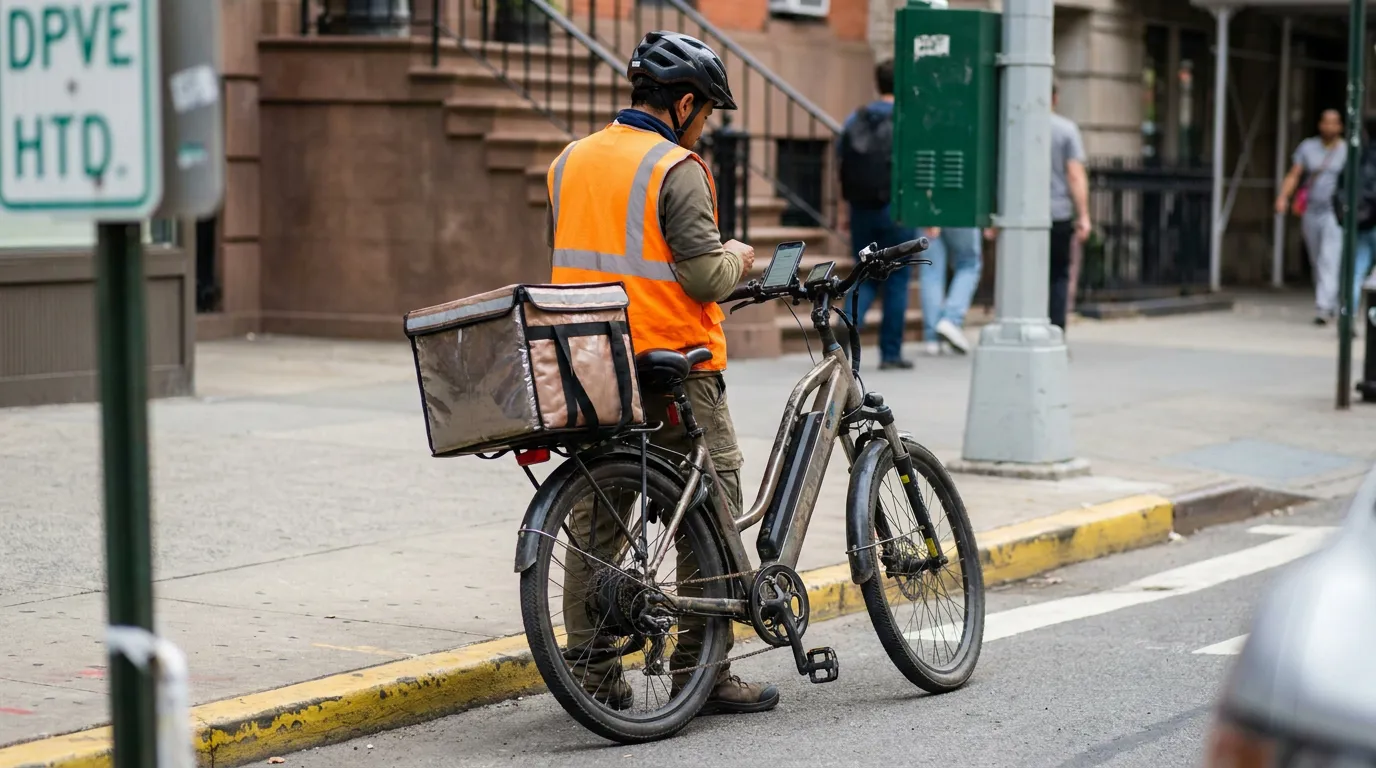
Preserve whatever identifies the rider and the operation. Photograph the bike, any delivery bag, branding, order receipts, and the rider’s phone screen if visible. Request the police report, seek medical evaluation the same day even if symptoms feel minor, and collect witness names and numbers before they disperse. Nearby businesses often overwrite surveillance footage within days, so a prompt preservation letter matters enormously.
💡 Pro Tip: Keep a short daily log of pain levels, missed work, and activities you cannot perform. Contemporaneous notes are frequently more persuasive than recollections assembled months later.
Similar analysis may apply to other commercial two-wheeled vehicles. If your case involves a scooter or moped rather than a pedal-assist bike, our discussion of commercial moped pedestrian liability walks through how classification may change the insurance analysis.
Frequently Asked Questions
1. Can I sue if I don’t know the rider’s name?
Often, yes. An investigation may identify responsible parties through delivery order records, restaurant dispatch logs, platform data, or surveillance footage. A delivery rider negligence claim may proceed against a restaurant or platform even where the individual rider is difficult to locate.
2. Does No-Fault cover my medical bills after an e-bike crash?
Generally not, because No-Fault benefits are tied to motor vehicles as defined by Insurance Law § 5102, and pedal-assist bicycles generally fall outside that definition. Health insurance typically becomes the primary payer, with medical expenses pursued as damages.
3. Do I need a "serious injury" to recover pain and suffering?
The Article 51 serious-injury threshold applies to covered persons in motor vehicle cases. It generally does not bar suits against bicyclists or non-motor-vehicle operators, so pain and suffering damages may be available without meeting that threshold.
4. How long do I really have to file?
Most negligence claims allow three years from the accident under CPLR 214, but wrongful death runs two years from the date of death under EPTL 5-4.1, and municipal claims require a notice of claim within 90 days under General Municipal Law § 50-e. Evidence can disappear long before any deadline arrives.
5. What if I was partly at fault?
Under CPLR 1411, your recovery may be reduced in proportion to your share of fault, but it is generally not barred unless you were solely responsible. Insurers frequently overstate a pedestrian’s fault, and the allocation is ultimately a question for the finder of fact.
Protecting Your Claim After a Delivery Bike Collision
Liability after a hit by delivery e-bike NYC collision usually depends on employment relationships, control over the delivery operation, device classification, and the insurance uncovered through disclosure. Three years is generally the negligence window under CPLR 214, but intentional-act framing, wrongful death, and municipal claims carry different timelines. Every outcome turns on the specific facts, the evidence preserved, and how quickly the investigation begins.
The Newman Firm handles pedestrian accident lawyer matters throughout Brooklyn, Queens, Manhattan, the Bronx, and Long Island. Speak with a member of our team at (718) 896-2700, visit our firm’s website to learn more, or schedule your consultation today.
Disclaimer: This content is for informational purposes only and is not legal advice. Every case is unique, and results may vary. Consult an attorney about your specific circumstances.